Bank Statement Analysis for CA Firms: How Smart Chartered Accountants Are Saving 20+ Hours Every Week
Published 2026-05-20 · Updated 2026-07-11
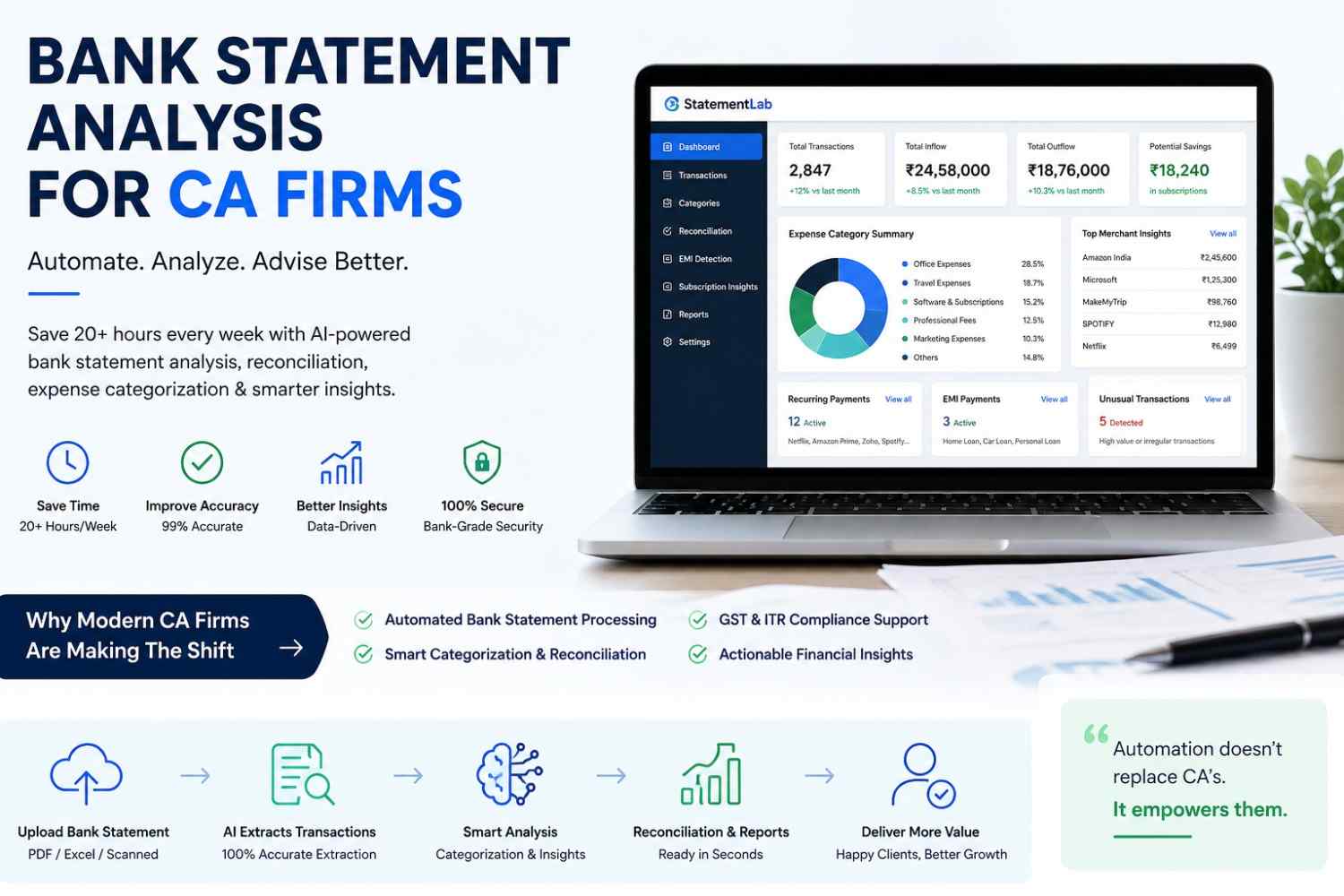
Chartered Accountant firms are increasingly adopting AI-powered bank statement analysis to automate the extraction and categorization of high-volume digital transactions like UPI and recurring subscriptions. By shifting from manual Excel workflows to automated systems, firms can save over 20 hours weekly, reducing reconciliation errors and freeing up time for high-value strategic advisory work.
Every CA firm knows this feeling.
It’s 11:30 PM during filing season.
The office lights are still on.
Excel sheets are open on multiple screens.
One employee is matching bank transactions manually.
Another is searching for missing entries.
Someone else is checking GST mismatches line by line.
And in the middle of all this chaos, one simple question keeps coming up repeatedly:
“Why does bank statement analysis still consume so much time?”
Honestly…
this is one of the biggest hidden operational problems inside many CA firms today.
Most accounting teams still spend countless hours manually:
And as transaction volume increases every year because of:
manual workflows are slowly becoming unsustainable.
This is exactly why modern CA firms are now shifting toward AI-powered bank statement analysis systems.
Not because it sounds futuristic.
But because it solves a real operational headache.
---
# Why Bank Statement Analysis Is So Important for CA Firms
For Chartered Accountants, bank statements are much more than simple transaction records.
They reveal:
In many cases, bank statements expose financial reality more clearly than manually prepared reports.
That’s why CA firms regularly analyze bank statements for:
The challenge is not understanding the importance.
The challenge is handling the workload efficiently.
---
# A Real Story From a Growing CA Firm in Pune
Last year, a mid-sized CA firm in Pune started facing a serious operational problem during GST season.
The firm handled around 70+ MSME clients.
Most clients submitted:
During filing deadlines, the accounting team was spending almost entire evenings manually:
One employee later admitted something interesting:
> “We were spending more time organizing financial data than actually analyzing it.”
That single statement explains the problem perfectly.
The issue wasn’t accounting expertise.
The issue was repetitive manual processing.
The firm later adopted an AI-powered bank statement analysis workflow.
Within weeks:
Most importantly…
their team finally had more time for advisory work instead of repetitive spreadsheet management.
This is the exact shift happening across modern accounting firms today.
---
# The Biggest Problems With Manual Bank Statement Analysis
Even experienced accounting teams struggle with certain challenges.
---
1. Transaction Volume Is Exploding
Modern businesses now generate hundreds or thousands of transactions monthly through:
Managing this manually is exhausting.
---
2. Excel Workflows Become Messy
Almost every CA firm has experienced:
As client volume increases, Excel becomes harder to manage efficiently.
---
3. Manual Categorization Wastes Huge Time
Teams often manually identify:
This repetitive work consumes hours every week.
---
4. Hidden Financial Insights Are Often Missed
Traditional reconciliation focuses mostly on matching numbers.
But clients today expect deeper insights like:
Manual workflows rarely uncover these insights properly.
---
# How AI-Powered Bank Statement Analysis Works
Modern AI systems are not just “PDF converters.”
They actually understand financial transaction behavior patterns.
This is where things become interesting for CA firms.
---
# Step 1 — Automatic Transaction Extraction
AI tools automatically extract:
from PDF bank statements instantly.
Even scanned bank statements can often be processed using OCR technology.
This alone saves enormous manual effort.
---
# Step 2 — Smart Expense Categorization
The AI automatically categorizes transactions into groups like:
For accounting teams, this dramatically reduces repetitive data organization work.
---
# Step 3 — Reconciliation Support
AI-powered systems can help identify:
This improves reporting accuracy while reducing manual verification work.
---
# Step 4 — Subscription & EMI Detection
Many businesses unknowingly continue paying for:
AI systems can automatically detect recurring patterns and highlight:
This creates much deeper financial visibility for clients.
---
# A Real Example Most Firms Relate To
A Delhi-based ecommerce client was spending nearly ₹18,000 every month on:
The business owner had absolutely no idea these costs were increasing gradually.
During statement analysis, recurring merchant patterns became visible immediately.
After removing unnecessary tools, the client reduced monthly operational expenses significantly.
Sometimes clients don’t just need compliance work.
They need financial clarity.
---
# Why Clients Expect More Than Basic Accounting Today
Modern business owners are changing.
They no longer want only:
They want:
This is where AI-powered financial analysis gives CA firms a major advantage.
---
# The Future of CA Firms Is Advisory + Automation
The accounting industry is evolving rapidly.
Manual data processing is slowly becoming less valuable.
Strategic interpretation is becoming more valuable.
Firms that combine:
will likely scale faster over the next few years.
Because clients increasingly prefer firms that:
instead of only generating reports.
---
# Security Matters More Than Ever
One concern many firms naturally have is data privacy.
And honestly…
they should.
Financial documents contain highly sensitive information.
Before using any bank statement analysis platform, firms should verify:
Trust is everything in financial services.
---
# AI Is Not Replacing Chartered Accountants
This is one of the biggest misconceptions in the industry.
AI does not replace financial expertise.
It removes repetitive operational work.
CA firms still provide:
AI simply allows professionals to spend more time on high-value advisory work instead of repetitive manual processing.
---
# Why This Shift Will Accelerate in 2026
The volume of financial data is increasing every year.
UPI growth alone has changed transaction behavior massively across India.
Businesses now deal with:
Manual reconciliation workflows are becoming increasingly difficult to scale.
That’s why intelligent financial automation is growing rapidly among:
---
# Final Thoughts
Bank statement analysis is no longer just a back-office accounting task.
It is becoming a financial intelligence process.
For CA firms, manual reconciliation and spreadsheet-heavy workflows consume enormous time while limiting scalability.
AI-powered bank statement analysis tools now help firms:
within seconds.
And honestly…
firms that adopt intelligent financial workflows early may gain a serious competitive advantage over traditional manual accounting operations in the coming years.
FAQ
What are the main challenges CA firms face with manual bank statement analysis?
Manual analysis often leads to duplicate entries, broken formulas, mismatched balances, and significant time wasted on repetitive categorization as transaction volumes from UPI and digital payments grow.
How does AI improve the transaction extraction process?
AI tools instantly extract debit/credit entries, balances, and narration details from PDFs or scanned statements using OCR, eliminating the need for manual data entry.
Can AI tools identify specific financial patterns like EMIs and subscriptions?
Beyond basic accounting, modern systems use pattern recognition to automatically detect recurring EMI payments, unused SaaS subscriptions, and unusual monthly deductions.
Is AI intended to replace the role of Chartered Accountants?
No. The technology is designed to remove repetitive operational tasks and manual processing, allowing CAs to focus more on tax planning, audit interpretation, and business consulting.
What security measures should CA firms look for in a statement analysis platform?
Firms should ensure any platform they use offers encrypted processing, secure file uploads, automatic data deletion, and privacy-focused infrastructure to protect sensitive client information.