Find Hidden Subscriptions in Your Bank Statement Before They Drain Your Money
Published 2026-05-18 · Updated 2026-07-11
Hidden subscriptions and auto-debits can silently drain thousands of rupees annually from your bank account due to complex merchant names and forgotten trials. Modern AI-powered statement analysis tools can automatically detect these recurring patterns, UPI mandates, and EMI deductions in seconds to help users regain control of their monthly budgets.
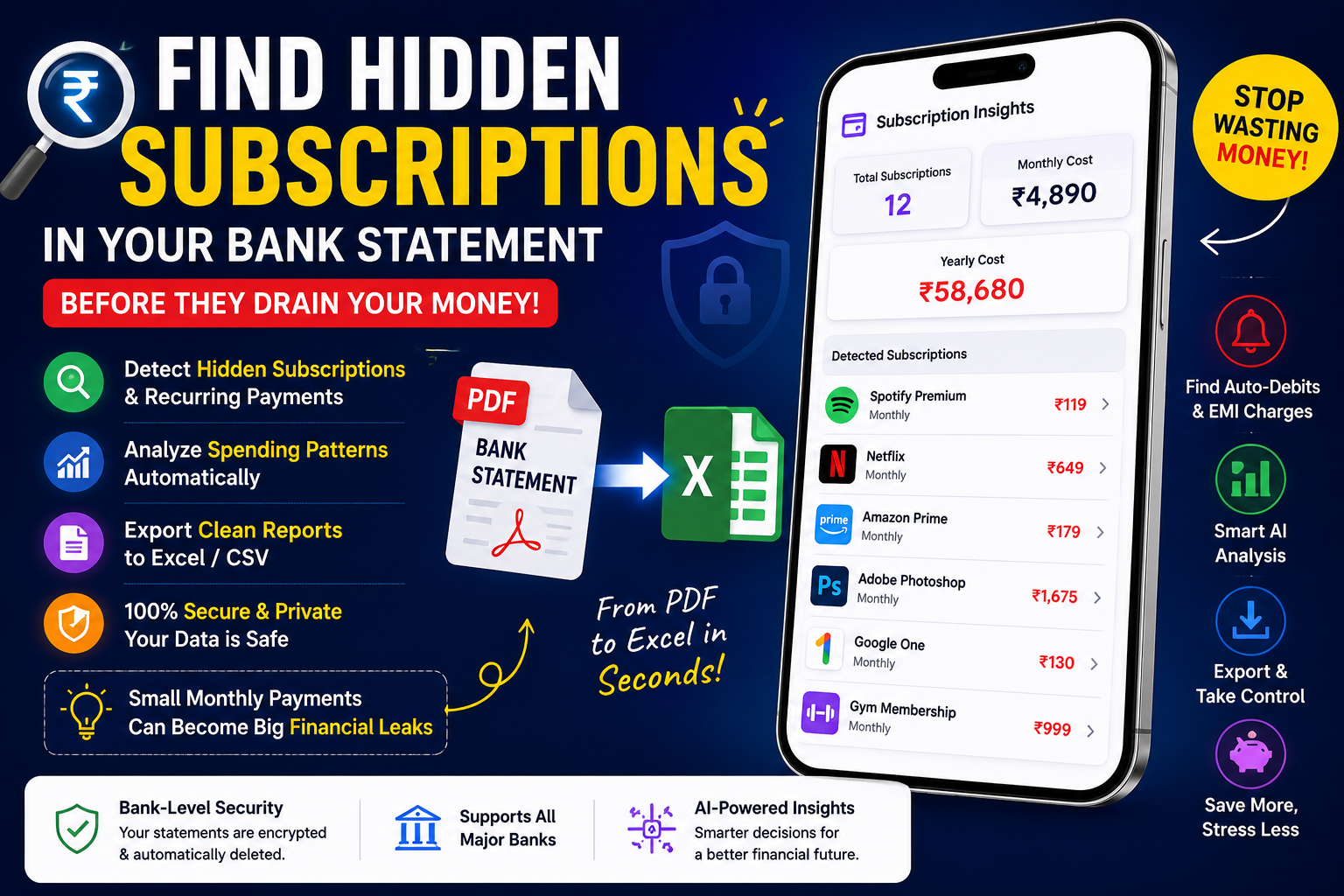
Most people think they know where their money goes every month.
But the reality is very different.
Hidden subscriptions, recurring payments, auto-debit charges, forgotten free trials, and silent EMI deductions quietly drain thousands of rupees every year without most users even noticing.
A ₹199 subscription may not feel dangerous.
But 8 to 10 recurring payments running silently together can become a serious monthly financial leak.
And honestly…
this is exactly how many people lose control of their monthly budget without realizing it.
The good news?
Modern AI-powered bank statement analysis tools can now automatically detect hidden subscriptions directly from your bank statement within seconds.
---
# What Are Hidden Subscriptions?
Hidden subscriptions are recurring payments that continue automatically every month, quarterly, or yearly.
These payments are often:
Most users stop tracking them after the first payment.
Common examples include:
Over time, these small charges become surprisingly expensive.
---
# Why Most People Fail to Detect Recurring Payments
Bank statements contain hundreds of transactions.
Manually identifying recurring patterns becomes extremely difficult because:
This is why many people continue paying for services they no longer use.
---
# Real Problem: Small Payments Become Big Financial Leaks
Let’s say you have:
Individually, these charges may look harmless.
But combined together?
They can easily cross ₹5,000–₹15,000 every month.
That’s a massive amount silently disappearing from your account every year.
And most people never calculate the yearly cost.
---
# How AI Detects Hidden Subscriptions Automatically
Modern AI bank statement analysis tools can now identify recurring payment patterns automatically.
Instead of manually checking every transaction, AI systems analyze:
This allows the system to detect:
within seconds.
---
# Step-by-Step Guide to Find Hidden Subscriptions
Step 1 — Upload Your Bank Statement
Upload your PDF bank statement securely using an AI-powered statement analyzer.
Most modern systems support:
and many other Indian banks.
---
Step 2 — AI Scans Transaction Patterns
The AI automatically extracts:
This process usually takes only a few seconds.
---
Step 3 — Review Subscription Insights
Advanced tools can now show:
This helps users understand exactly where money is leaking every month.
---
# Common Hidden Charges People Ignore
Many recurring expenses are surprisingly easy to forget.
Popular examples include:
OTT Platforms
Netflix, Prime Video, Hotstar, Spotify.
Shopping Memberships
Amazon Prime, Flipkart Plus, loyalty plans.
Auto-Debit EMIs
Personal loans, BNPL payments, financing apps.
App Subscriptions
Editing apps, cloud storage, AI tools, premium utilities.
Insurance & Utility Bills
Electricity, broadband, mobile recharge automation.
---
# Why Subscription Tracking Matters in 2026
Digital payments are growing rapidly.
Most users now pay through:
This convenience creates a hidden danger:
people stop tracking small recurring expenses.
That’s why AI-powered subscription tracking is becoming an important part of personal finance management.
---
# Hidden Subscriptions Can Hurt Savings & Loan Eligibility
Many users don’t realize this…
High recurring expenses can reduce:
Banks and lenders often analyze spending patterns before approving loans.
Too many recurring obligations can negatively affect financial health.
---
# AI-Based Subscription Detection Is More Accurate
Traditional expense tracking apps often miss:
AI-powered financial analysis tools perform much deeper analysis using transaction behavior patterns.
This creates more accurate subscription detection and spending analysis.
---
# Benefits of Detecting Hidden Subscriptions
Finding recurring payments early can help you:
Even removing 2–3 unnecessary subscriptions can create noticeable monthly savings.
---
# Best Features to Look for in Subscription Detection Tools
Before using any tool, check whether it offers:
Security is especially important when uploading financial documents.
---
# Final Thoughts
Most people underestimate how much money quietly disappears through recurring payments.
The scary part?
These subscriptions usually continue for months or even years without attention.
Modern AI-powered bank statement analysis tools now make it possible to detect hidden subscriptions, recurring charges, EMI payments, and financial leaks automatically within seconds.
Instead of guessing where your money goes…
you can finally see the complete picture clearly.
FAQ
What are hidden subscriptions in a bank statement?
Hidden subscriptions are recurring payments for services like OTT platforms, cloud storage, or memberships that continue automatically and are often forgotten or ignored by the user.
How does AI detect recurring payments automatically?
AI tools analyze transaction behavior, including recurring dates, merchant names, payment intervals, and repeated UPI references to identify patterns that manual reviews might miss.
What features should I look for in a subscription detection tool?
Users should look for features such as bank statement categorization, EMI detection, merchant analysis, encrypted processing, and the ability to export data to Excel or CSV.
Can hidden subscriptions affect my loan eligibility?
High recurring expenses can reduce your disposable income and EMI affordability, which may negatively impact your financial health and loan approval chances when banks analyze your spending.
Why is it hard to find subscriptions manually in a bank statement?
Manual detection is difficult because merchant names are often confusing, UPI references look random, and auto-debits are frequently hidden among hundreds of normal daily transactions.